
Ernö Metzner's Polizeibericht Überfall + Werner Hochbaum's Brothers
Tuesday, August 11, 2026 at 7pm
Light Industry, 361 Stagg Street, Suite 407, Brooklyn
Polizeibericht Überfall (Accident), Ernö Metzner, 1928, 16mm, 21 mins
Brothers (Brüder), Werner Hochbaum, 1929, 78 mins
Though the Weimar era represents one of the more familiar and beloved avenues of repertory cinema, many of its side streets, exceptional in their own right, remain under-explored by today’s rep rats. This evening slips down two such alleys. We first learned of Brothers, the debut feature by Werner Hochbaum, from its inclusion in the series Annette Michelson organized as part of the ICA Boston’s 1992 exhibition Montage and Modern Life, where it screened alongside Sergei Eisenstein’s October and King Vidor’s The Crowd, among others. And indeed you will find, in Brothers’s overall design, an illustration of how the Soviet revolution in editing first expanded to Europe and beyond. But there is still more to this film, whose central drama is the Hamburg dockworkers’ strike of 1896-97, and in which a nonprofessional cast of dockworkers starred. As a movie produced with the support of both unions and the Social Democratic Party, it’s a revealing experiment in filmmaking underwritten by working-class institutions—the film was often shown at labor meetings following its initial release, a catalyst for members to reflect on their own circumstances. Perhaps more memorable than Brothers’s montage are its compositions: of a harbor half-frozen, a fist clenched, a face enervated by illness. So much of the film’s power resides, unexpectedly, in its moments of stillness and stasis.
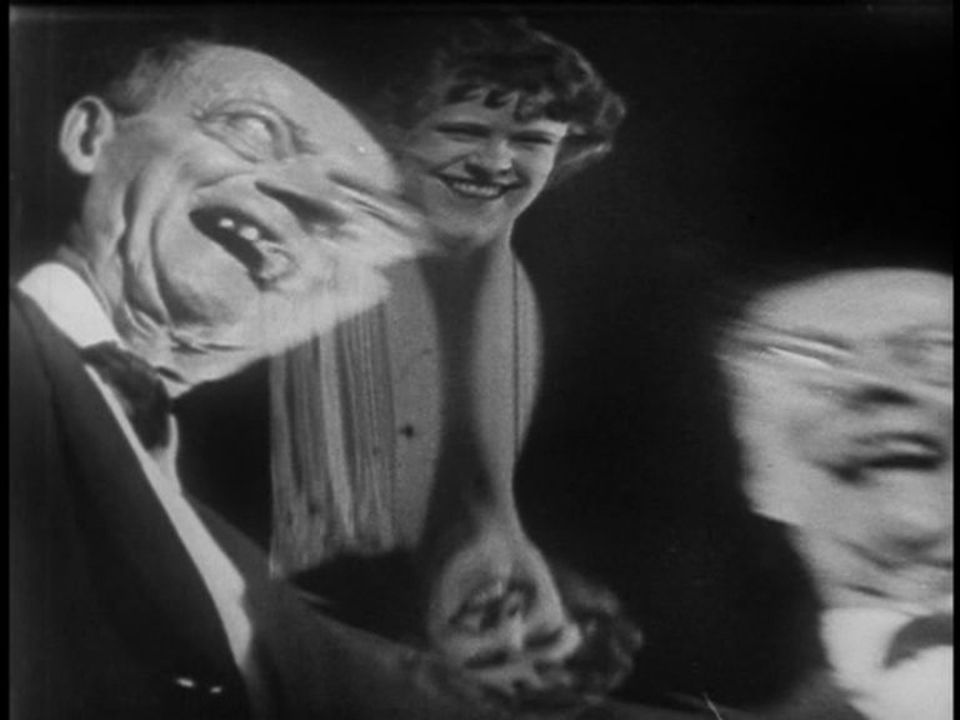
Opening the double bill is Ernö Metzner’s Polizeibericht Überfall, another important silent film to emerge from the German left of the 1920s (Metzner cut his teeth making propaganda films for the SDP). Here is a weird tale of a man who stumbles upon a coin that, unbeknownst to him, brings its owner ill fortune. What follows is a parade of ignominy, a fable about the curse money casts upon human affairs, which culminates in an extended sequence of hallucinatory anamorphic distortion. The film was swiftly dubbed criminal by local censors, and banned on account of its “brutal and demoralizing effect,” as historian Anton Kaes has noted. The suppression also baffled the editors of the great modernist movie mag Close Up, who published the official ruling in its pages. Überfall may not have been seen in Weimar Berlin, but it found audiences elsewhere. Light Industry’s score, for instance, will follow the cues given for its 1947 presentation in San Francisco, as part of Frank Stauffaucher’s Art in Cinema series. The instructions recommend precise excerpts from a Leo Sowerby symphony for organ, accompaniment that seems most appropriate to Überfall’s eerie atmospheres.
Print of Überfall courtesy of the Bard College 16mm Film Library.
Tickets - Pay what you can ($10 suggested donation), available at door.
Please note: seating is limited. First-come, first-served, except for members subscribed at $8/month or more, who may reserve a seat by emailing information@lightindustry.org at least two hours prior to showtime. Box office opens at 6:30pm. No entry 10 minutes after start of show.