
Alfred E. Green’s Four Faces West + André de Toth’s Ramrod
Tuesday, October 13, 2026 at 7pm
Light Industry, 361 Stagg Street, Suite 407, Brooklyn
Presented by Narrow Margin
7pm
Four Faces West, Alfred E. Green, 16mm, 1948, 90 mins
9pm
Ramrod, André de Toth, 16mm, 1947, 95 mins
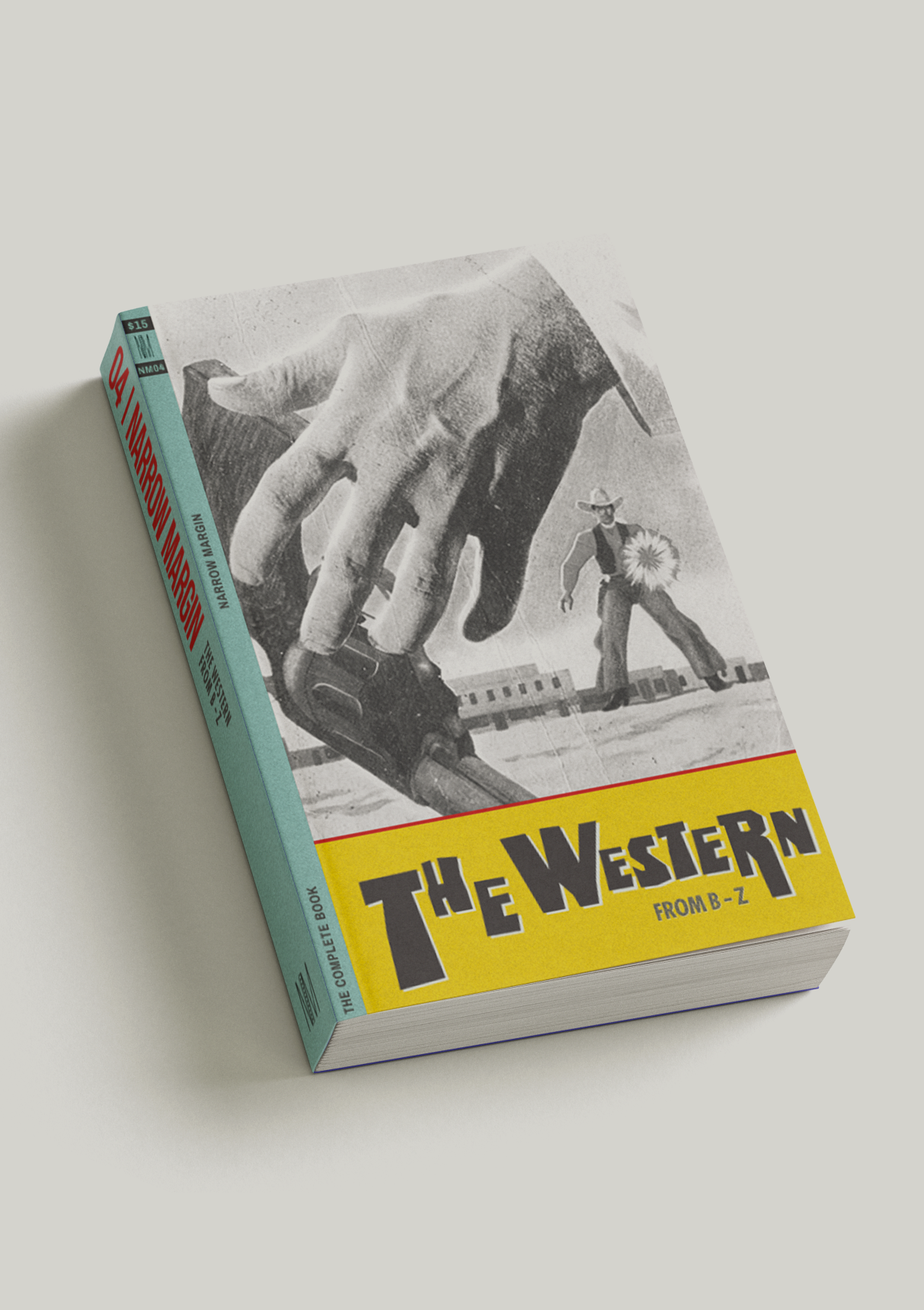
To mark the release of the fourth issue of Narrow Margin, its editors will present two rarely-screened westerns starring Joel McCrea: Four Faces West, directed by Alfred E. Green, and Ramrod, directed by André de Toth. Issue four, The Western: From B-Z, is dedicated to westerns made at the margins, produced with little means and made from the scraps of the studio system: cheap programmers of Poverty Row, seventy-minute features of cowboys with guns ablaze on the backlot. At once popular and peripheral, these westerns were the morass upon which American cinema was built, the crude oil that fueled an empire. However, they also exist in another lineage, one that includes the films of Luc Moullet, Paul Vecchiali, and any other filmmaker who made art with a poverty of means. With meager resources at their disposal, the filmmakers of these minor westerns discovered that simplicity is often the most honest attitude toward all that is criminal and beautiful in cinema’s Wild West.
*
Ramrod and Four Faces West not only star Joel McCrea, one of the horse opera’s most cherished stars during the 1940s and 50s; both were also photographed by Russell Harlan, who would go on to shoot Red River, Lust for Life and Hatari!. Just from this partial filmography, Harlan’s sensitivity to the landscape and its inhabitants is obvious: the shrublands traversed by thousands of cattle in Red River; the grasslands filled with giraffes, elephants, and rhinos in Hatari!; the pastoral landscapes of Auvers-sur-Oise and Arles in Lust for Life.
Shot on location in Zion National Park, de Toth’s Ramrod is especially sensitive to the life of the desert landscape. The film is the first of a cycle of westerns about ranching released after WWII: Hawks’s Red River, Walsh’s The Tall Men, Mann’s The Furies, Fuller’s Forty Guns, Dwan’s Cattle Queen of Montanna. Like these other westerns, Ramrod gorgeously captures the landscape and the cattle that travel through it. Yet de Toth adopts a quieter tone than Hawks and his sublime bovine masses, more modest in his portrayal of ranch life. His film depicts Zion and its animal inhabitants with relished happenstance: cattle, horses, chickens, goats, and deer living out their own little dramas with not a care in the world for McCrea and his co-star. As the Los Angeles Times reported of Ramrod in 1946: “A deer, uncalled for in the script…moved into the scene just as cinematographer Russell Harlan began shooting it, and practically stole the scene from Joel McCrea and Veronica Lake.” Ramrod reveals something almost too embarrassing to state but which will remain profound whenever it is shown: there is beauty in simplicity. Sometimes, a horse wide-eyed and lapping water from the Colorado River is more than enough.
*
Perhaps most well-known as the western in which not a single shot is fired, Green’s Four Faces West is a parable of fundamental values: self-respect, courage, and integrity. The film was part of a trend of postwar westerns that offered an escape from the paranoia of McCarthyism and the Cold War: Tourneur’s Stars in My Crown, Springsteen’s Hellfire, Witney’s Stranger at My Door, and Ford’s Wagon Master. Against the cynicism of a High Noon or even a Silver Lode, these films embraced the naïveté of their genre, treating it as a Saturday matinee sermon on doing right by one’s neighbor.
The film’s protagonist Ross McEwen (played by McCrea) is a good man who has done a bad thing to help those he loves: robbing a bank to support his impoverished father. Over time, he’s been repaying the bank anonymously, mailing back cash whenever he is able to find occasional work or win a little bit of money from gambling. Ultimately, McEwen must decide whether or not to turn himself in—to resolve whether he was justified in acting according to his own moral code. Unlike the westerns of Anthony Mann starring Jimmy Stewart and Gary Cooper, Four Faces West is not about a bad man making good but a good man who might have done wrong. The question the film asks is a fundamental one: “Can past wrongs be righted?” Though the story concerns McEwen’s past transgression, the crimes of history—the violent conquest of the American West—haunt the images of Four Faces West.
Green’s story of redemption is set around El Morro. Otherwise known as Inscription Rock, this immense slab of limestone is covered with carved words and figures made across several epochs, from the Ancestral Puebloans to Spanish conquistadors, American land surveyors, and other early settlers. “Isn’t it strange, how everything is made from sacrifice,” Fay Hollister asks, standing before the rock and its countless etchings. Like so much of the dialogue in this film, Hollister’s remark carries at least two meanings: one that refers to the generations of people who have inscribed their messages in the rock, the other to the decision McEwen must ultimately make to retain his self-respect. McEwen’s past comes back to haunt him in an environment possessed by other crimes: all the men and women “sacrificed” in the making of the West.
This history of conquest emerges not just in the story and its setting but also in the way they are shown, the style of the film’s landscape cinematography harkening back to earlier visual traditions. For the scenes shot on location, Harlan drew on pre-existing photography of the American West, particularly the 1870s photographs of Timothy O'Sullivan. Four Faces West almost exactly recreates two of his photographs of El Morro. Moreover, when McEwen sets the canyons aflame, it is hard not to see O’Sullivan’s well-known photograph of Canyon de Chelle. In that image, O’Sullivan depicts an entirely depopulated terrain marked by the ruins of Puebloan cave dwellings. Only a decade prior, Navajo were forcibly removed from those canyons by Kit Carson, who scorched their farmland and killed their livestock. When McEwen sets the landscape ablaze, this other past leaks into the film: one that cannot or will not be righted. McEwen’s reflection of his own deeds might as well reflect the mindset of innumerable Americans: “If we can forget what’s happened, I think it’s worth it.”
Four Faces West appears to be a naive story of doing good and paying one’s debts yet it communicates something far more ambivalent and mysterious. However direct and candid they may appear, every image, phrase, and gesture invites multiple readings; even McEwen’s final, seemingly valiant act leaves an aftertaste more sour than sweet. Perhaps the western remains fascinating because so often it ends with questions rather than answers, its simplicity in fact an irresolvable multiplicity.
- John Winn
Copies of the print edition of the fourth issue of Narrow Margin will be for sale at the event.
Tickets - Pay what you can ($10 suggested donation), available at door. One ticket good for both shows.
Please note: seating is limited. First-come, first-served, except for members subscribed at $8/month or more, who may reserve a seat by emailing information@lightindustry.org at least two hours prior to showtime. Box office opens at 6:30pm and re-opens at 8:30pm. No entry 10 minutes after start of show.