
Chris Marker’s The Train Rolls On + Alexander Medvedkin’s Happiness
Tuesday, September 22, 2026 at 7pm
Light Industry, 361 Stagg Street, Suite 407, Brooklyn
The Train Rolls On, Chris Marker, digital projection, 1971, 32 mins
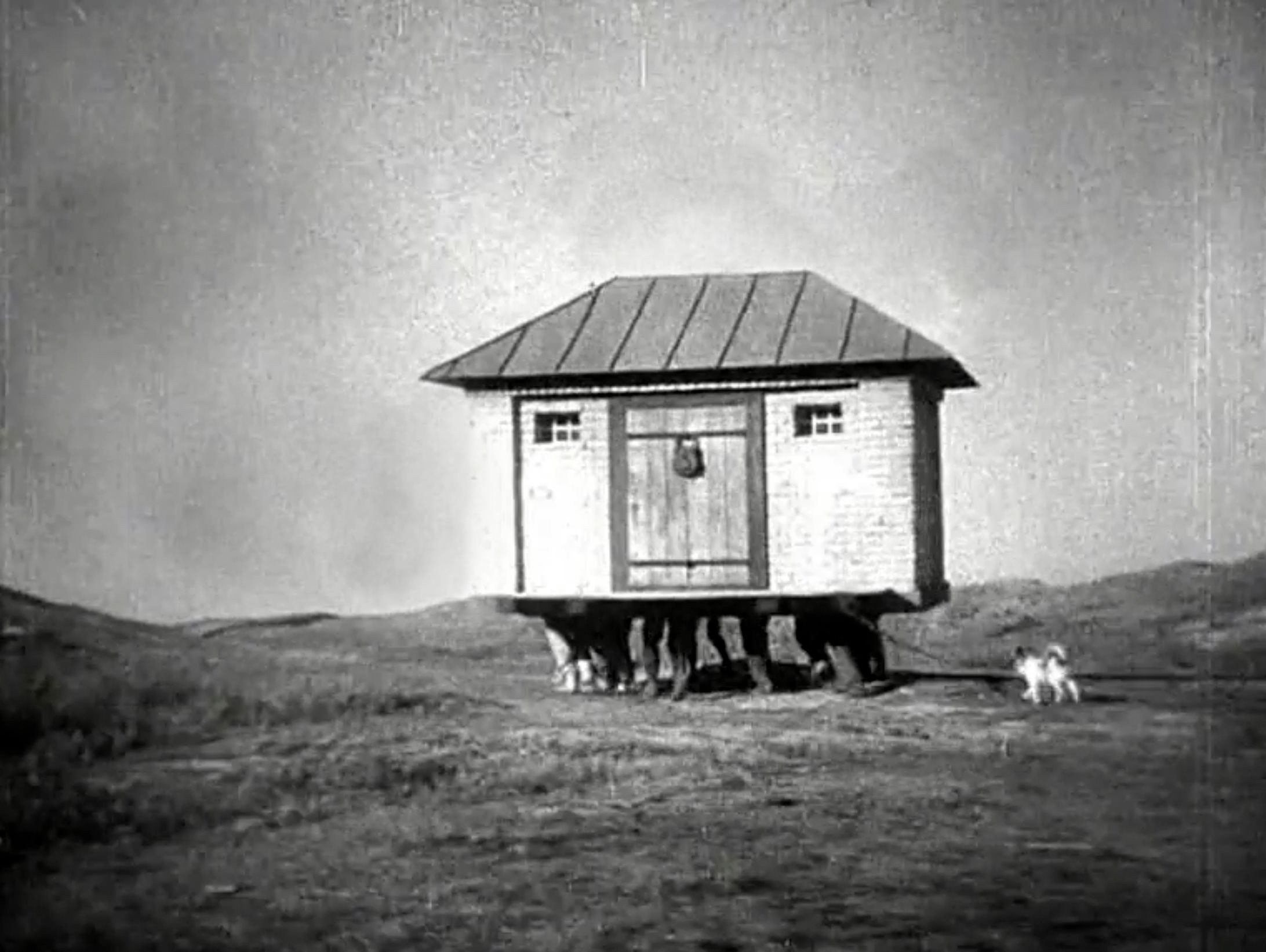
Happiness, Alexander Medvedkin, digital projection, 1934, 66 mins
“Just now—today—I have seen our laughter on the screen. And for the second time in just five days I am driven to exclaim with enthusiasm over yet another achievement of our cinema.
Today I saw Medvedkin’s comedy, Happiness, and to use the common expression, I cannot remain silent.
Today I saw how a Bolshevik laughs.
One may begin a comedy with the declaration that Chaplin has no part in it. And it will indeed turn out that Chaplin has no part in it.
But one may also make a comedy without thinking about Charlie, and it will turn out that he is in it.
Not Chaplin himself, or something borrowed from him. But Chaplin as an indication of magnitude, as a basis for reference, as something profoundly specific.
Chaplin ‘in a new quality.’”
So begins Sergei Eisenstein’s 1935 review of Alexander Medvedkin’s Happiness, one of the very last silent films made in the Soviet Union. Eisenstein’s excitement for this “new quality,” a kind of communist slapstick, was not, unfortunately, shared by all his contemporaries, and the film was quickly suppressed. Virtually forgotten, Happiness was thought lost until its rediscovery by Jacques Ledoux of the Cinémathèque Royale de Belgique in Brussels, who screened it at a 1961 retrospective of Soviet film attended by Ledoux’s friend, Chris Marker. An astonished Marker then became obsessed with finding the film’s creator. In 1967, he participated in the formation of les groupes Medvedkines—filmmaking collectives formed among striking textile and auto workers—and eventually interviewed Medvedkin on-camera for the SLON production The Train Rolls On. Soon after, Marker helped re-release Happiness to cinemas in 1971, preceded by the SLON film for its French run.
Happiness is a movie about the misadventures of a peasant (“the last lazybones of the collective farm,” as Medvedkin puts it), who feels out of place in both the old, pre-revolutionary order and the new. It’s realized through a series of unforgettable set pieces—one might recall its slack-jawed soldier masks from the cover of Kino, Jay Leyda’s classic history of Soviet cinema—but this dreamy fable, Marker came to learn, had its origins in the now-legendary kinopoezd, or cine-train.
As Medvedkin explains in The Train Rolls On, he and dozens of comrades outfitted a locomotive as a complete system of film production, with cars for lab processing, editing, and all that was required to shoot and immediately screen films for their audiences, whom they visited along the country’s vast rail networks. This traveling collective focused their cameras on the workers enacting the First Five-Year Plan, and found occasion for both celebration and critique, offering at each stop visual evidence of that locale’s impressive accomplishments in agriculture and industry, as well as the errors and inefficiencies that would inevitably arise in the course of such a grand transformation. These direct encounters with the day-to-day struggles of the people would later provide the raw material for Medvedkin’s satire, a form he understood to have militant potential.
“The cine-train has become something of a myth for us,” Marker’s narration concludes, “as if in spite of differences and the width of the rail gauge, it had broken through its own time and place to join everything that is advancing and moving; the cine-train, the train of revolution, the train of history, has not lacked reverse and switched points, but the biggest mistake one could make is to believe that it had come to a halt.”
Tickets - Pay what you can ($10 suggested donation), available at door.
Please note: seating is limited. First-come, first-served, except for members subscribed at $8/month or more, who may reserve a seat by emailing information@lightindustry.org at least two hours prior to showtime. Box office opens at 6:30pm. No entry 10 minutes after start of show.