
Jonas Jonas's Double Lunar Dogs + George Pal's Destination Moon
Tuesday, August 18, 2026 at 7pm
Light Industry, 361 Stagg Street, Suite 407, Brooklyn
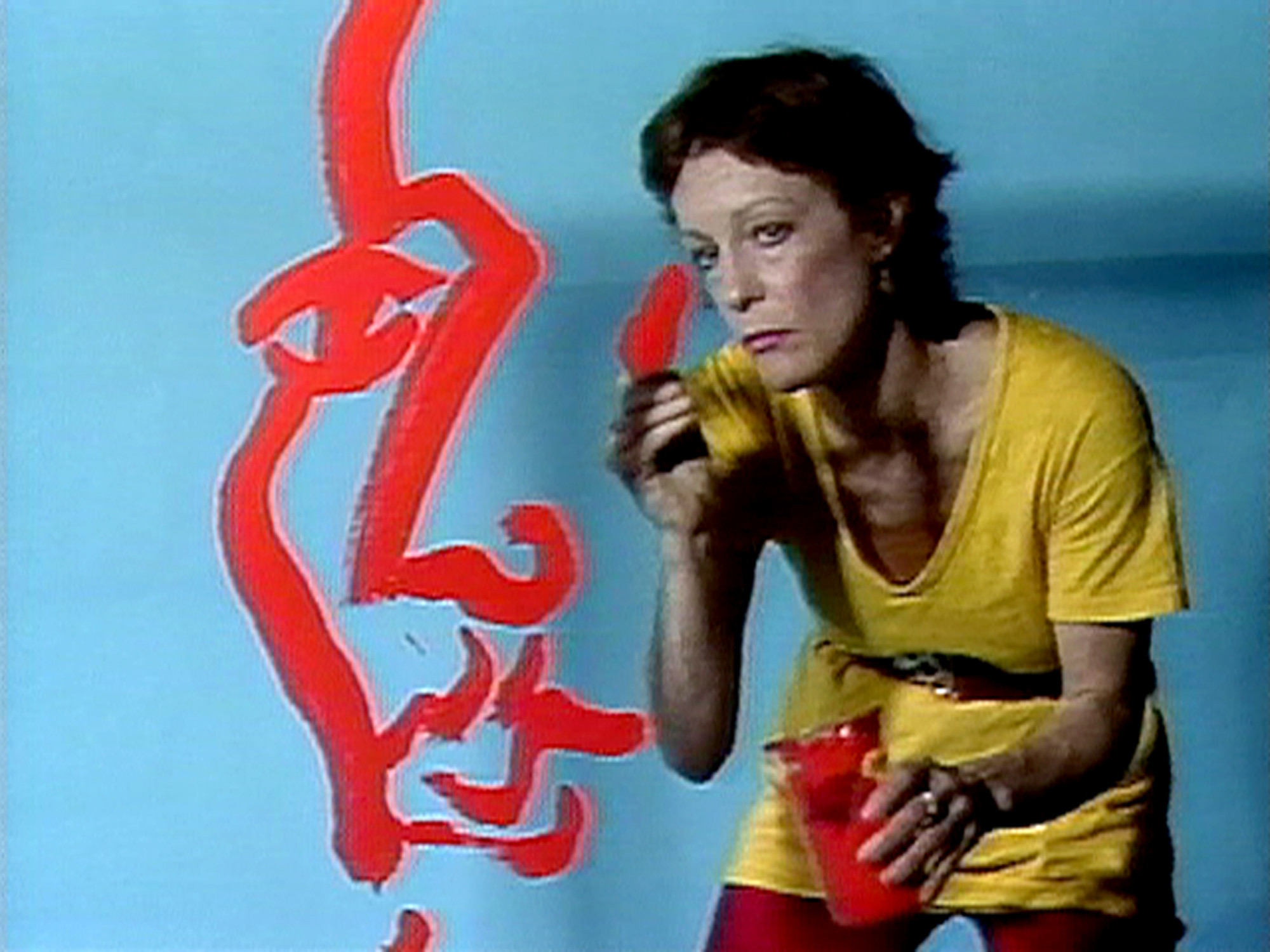
Double Lunar Dogs, Joan Jonas, 1984, digital projection, 24 mins
Destination Moon, Irving Pichel, 1950, digital projection, 91 mins
Robert A. Heinlein’s significance, his influence on the ambitions of speculative fiction (a term he coined) is hard to overstate. He is remembered not only for his prolific output and formal sophistication, but also his outspoken and unconventional politics, which veered from socialism to libertarianism over the course of his life, but always resisted easy categorization. A Heinlein tale might seem to celebrate military service, free love, or both. In Samuel Delany’s study of the elder author, he observed that “modern critics attempting to wrestle with that influence find themselves dealing with an object rather like a sky or ocean. In many respects, Heinlein’s limits are the horizons of science fiction.” This evening, we present two very different translations of Heinlein’s work to the screen: George Pal’s 1950 Hollywood spectacular Destination Moon and Joan Jonas’s gnomic 1984 video Double Lunar Dogs.
Co-written by Heinlein himself, Destination Moon was one of American cinema’s earliest attempts to make a serious, big-budget sci-fi film, and the first such production from animation and practical-effects legend George Pal, who would continue to push the genre forward with later titles such as When Worlds Collide, The War of the Worlds and The Time Machine. The screenplay collages elements from Heinlein’s postwar juvenile Rocket Ship Galileo and his novel The Man Who Sold the Moon, envisioning a US lunar mission almost two decades before it became reality—here as a Cold War defense project led by a charismatic titan of private industry. (Today its scenario, J. Hoberman noted, seems “far more concerned with geopolitical danger than extraterrestrial exploration.”) As chronicled in a behind-the-scenes report written by Heinlein for the July 1950 issue of Astounding, the author was an active presence on set as technical advisor. Working together with iconic sci-fi illustrator Chesley Bonestell, who provided astronomically correct matte paintings for its backgrounds, Heinlein insisted that the movie avoid the loosey-goosey approach to physics that had been the Flash Gordon standard. He “saw to it that what went on the screen was as accurate as budget and ingenuity would permit,” targeting “the ‘Hollywood’ frame of mind,” of “people in authority who either don't know or don't care about scientific correctness and plausibility.” A hit with audiences upon its release, Destination Moon also garnered the praise of figures like Isaac Asimov and Arthur C. Clarke. Its otherworldly vistas and inspired simulations of cosmic travel would not be matched until 2001: A Space Odyssey many years later.
A micro-budget endeavour by comparison, Double Lunar Dogs opens with Jonas’s voice: “Imagine yourself on this spaceship that has been travelling for hundreds of years,” she says over footage of a drifting satellite. “You, the inhabitants, were born here, and will die here. Everyone has forgotten where they came from and where they are going. But the ship which nurtures you hums on and on.” Taken from Heinlein’s 1941 story “Universe” (later published as the 1963 novel Orphans of the Sky), the premise provides a frame for Jonas and her collaborators (Spaulding Gray, Simone Forti, Richard Teitelbaum, and the Vasulkas, among others). She stages a series of inscrutable, ritualistic performances—stolen views of some future society. At times lit with vibrantly monstrous colors a là Creation of the Humanoids, the material gets flipped, warped, and otherwise distorted throughout by an array of image-processing tools. Double Lunar Dogs is a strange and stellar product of the 80s avant-garde, one that might double as a kind of allegory for New York or America or other floating worlds.
Tickets - Pay what you can ($10 suggested donation), available at door.
Please note: seating is limited. First-come, first-served, except for members subscribed at $8/month or more, who may reserve a seat by emailing information@lightindustry.org at least two hours prior to showtime. Box office opens at 6:30pm. No entry 10 minutes after start of show.